

Copy of a Copy of a Copy of a
From noize-y backrooms to the future of art

Two pieces of art that have intrigued and excited me in the past two months: Nine Inch Nails’ collaboration with electronic music producer Boys Noize, united under the name Nine Inch Noize, and Kane Parson’s debut feature film, Backrooms.
I discovered the former via YouTube clips from their Coachella performances in early April. I’d already heard that NIN’s Peel it Back tour had incredible staging, sound and visuals, but NINoize’s Coachella show massively stepped up the production, far surpassing my expectations.
The closest live performances I can compare it to are Kendrick Lamar’s 2022 Glastonbury headline set — specifically, the use of a contemporary dance troupe as the primary visual focus, often upstaging Lamar — and English choreographer Akram Khan’s XENOS, which featured a steeply-declined platform dominating the stage. It’s hard to describe XENOS’ awe-inspiring set design in words, so here’s a photo, and the show’s trailer is below.
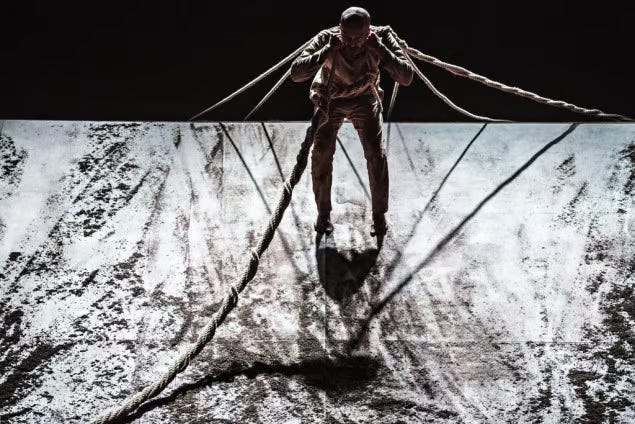
I saw both shows in-person and I still consider them peaks of innovation in live music and dance. What captivated me most about their unorthodox staging and choreography was how the audience accepted and connected to it. Standing in the field or sitting in the theatre, it felt like our collective energy willed the performers to overcome challenges — in Khan’s case, to repeatedly ascend and descend from a substantial height — to present their new, bold, live art.
Witnessing a show as ambitious and unparalleled as XENOS reminded me how exhilarating and memorable live performances can be. An experience that can never be supplanted by technology. What makes these shows special and undeniably human? In a word: authenticity.
A week after Coachella, a self-titled Nine Inch Noize album was released. Will Lynch wrote about its genesis, quoting band leader Trent Reznor, in his Pitchfork review:
It’s not clear exactly when and where the recordings on this album come from. “We recorded this album all over the place,” Reznor said. “Some of it’s live, some in studios, hotels, planes, etc.” Anyone hoping for lovingly perfected versions of those heard on the Peel It Back tour may be disappointed. Live or not, this album has crowd noise, and something less than the cut-glass perfection of a studio album.
Assuming some songs were recorded live in concert, it boggles my mind as to why the crowd noise was kept in. It’s unnecessary, distracting, bordering on gimmicky. (And I adore many live albums! I wrote about my favourites here.) Nine Inch Nails’ studio albums have been consistently pristine in their production, so I don’t understand why there is sporadic “live” noise on these recordings. It’s not been marketed as a live record. Will Lynch explained the result better than I could:
the way the cheers of the crowd fade in and out at contrived moments, rather than running low in the mix throughout the whole record, has the unfortunate effect of making it feel a little canned, almost like a laugh track.
Don’t get me wrong, I like the album, but my impression is that it is trying to serve one too many purposes: a cross-genre collaboration, a live performance capture, a reinvention of Nine Inch Nails’ back catalogue. Any one or two of these functions alone would make it a successful project. But the addition of an audience on some tracks, regardless of if it’s real or canned, makes the whole record sound hollow. Case in point: the reinvention of NIN’s massive 1994 radio hit “Closer” — note how the audience conveniently goes silent at 1:03, just as Reznor starts singing. (Otherwise, it’s a brilliant remix.)
My question to Reznor and Co: why muddy the experience of this album? Why present it as something other than what it is?
My question to anyone listening: does authenticity matter?
On Wednesday, I watched Backrooms with my pal Kristian (of OneTrackMinds fame) at the Curzon cinema in Soho. I’ve since read and listened to a bunch of reviews and analyses; Richard Osman, on The Rest is Entertainment, described it as “more of a mood than a film”, which resonated with me. I loved the mood and the mystery of Backrooms. I’m not sure I’ve seen a film like it before.
I won’t reveal any spoilers here. In a Guardian interview, director Parsons articulated the philosophical meaning that I gleaned from the film.
Everywhere is starting to look more and more the same, and we’re drowning in information. But all that information is just turning into a cloud of noise that feels very meaningless. We’re hitting a place where information about our world is getting filtered through so many systems that are inherently putting it through a blender and regurgitating it back out in a pretty distorted form.
The metaphorical “cloud of noise” and literal “distorted forms” in Backrooms are captivating — and precisely what bothered me about Nine Inch Noize. That’s no diss to Nine Inch Nails and Boys Noize; Reznor has always been innovative and risk-taking, more so than most popular musicians and producers. Given the ascent of Artificial Intelligence, though, I wonder if both artworks are comments on, and glimpses of, the future: filtered realities, unnecessary repetitions, hollow reinventions, resulting in contrived environments (the liminal spaces depicted in Backrooms) and contrived experiences (listening to Nine Inch Noize).
I’ve been reluctant to write about it, but I’m worried about AI. Is this the future we want? Copies of copies of copies, ad infinitum, resulting in inauthentic art…?